The Unexpected Genesis: From NASCAR Race to Viral Phenomenon
In the intricate tapestry of modern political discourse, few phrases have captured public attention and divided opinion quite as rapidly as "Let's Go Brandon." What began as an innocent, albeit misreported, cheer for a NASCAR driver quickly morphed into a clandestine rallying cry, echoing across the nation from political rallies to everyday conversations. This remarkable transformation highlights the speed at which symbols and slogans can permeate our culture, serving as a powerful, albeit coded, expression of sentiment.
The phrase's origin story is as unique as its impact. It wasn't born in a political campaign office or on the floor of Congress, but rather at a seemingly ordinary sporting event. This unexpected beginning is crucial to understanding its widespread adoption and the layers of meaning it has accumulated. It capitalized on a moment of genuine confusion, creating a clean, palatable substitute for a much cruder sentiment, allowing it to bypass social filters and become a mainstream phenomenon.
The Accidental Birth: Talladega, Brandon Brown, and a Reporter's Mistake
The precise moment "Let's Go Brandon" entered the public lexicon can be traced back to October 2, 2021, at the Talladega Superspeedway in Alabama. NASCAR Xfinity Series driver Brandon Brown, a 28-year-old talent driving for an often underfunded, family-owned team, had just achieved a monumental milestone: his first career victory. It was a jubilant moment, a hard-earned triumph for a driver who had consistently battled resource limitations.
During his post-race interview with an NBC Sports reporter, the crowd in the stands behind him began to chant. The reporter, perhaps caught up in the excitement or genuinely mishearing the boisterous crowd, interpreted their rhythmic shouts as "Let's go, Brandon!" – a cheer for the victorious driver. However, it quickly became apparent that the crowd's actual chant was far less benign, explicitly aimed at President Joe Biden with an expletive-laced dismissal. The reporter's on-air misdirection, whether intentional or not, inadvertently provided the perfect cover.
This moment was immediately seized upon, especially by those looking for a way to express their disapproval of the President without resorting to overtly vulgar language. The G-rated camouflage offered by "Let's Go Brandon" made it accessible to a broader audience, including families and public figures who might otherwise shy away from using the original, more explicit phrase. The phrase resonated because it provided a socially acceptable workaround, a veiled insult that could be uttered in various contexts without immediate direct repercussions. For a deeper dive into this phenomenon, read our article on
Unpacking "Let's Go Brandon": Origin, Meaning, and Political Rise.
From Coded Message to Republican Rallying Cry
The beauty, or perhaps the cunning, of "Let's Go Brandon" lies in its ability to convey a strong political message while maintaining an outward appearance of innocuousness. It became an inside joke for a segment of the population, a wink and a nod that signaled shared opposition to President Biden's administration. This hidden layer of meaning allowed it to spread with unprecedented speed, particularly among conservative circles.
Within weeks of its NASCAR debut, the phrase transcended sports arenas and began appearing in overtly political settings. Republican figures, recognizing its potency as a unifying slogan for their base, swiftly adopted it.
*
Congressional Endorsements: Republican Rep. Bill Posey of Florida notably concluded an October 21 House floor speech with a fist pump and the cryptic phrase, criticizing Democrats and saying Americans want them to "help put America back where you found it and leave it the hell alone. Let's go, Brandon!" This move signaled the phrase's official entry into the political mainstream.
*
Gubernatorial and Senatorial Amplification: Texas Gov. Greg Abbott tweeted the phrase, further solidifying its presence. Senators Ted Cruz and Mitch McConnell also associated with it, with Cruz posing with a "Let's Go Brandon" sign at the World Series and McConnell's press secretary retweeting a photo of the phrase on a construction sign. South Carolina Republican Jeff Duncan even wore a "Let's Go Brandon" face mask at the Capitol.
*
Campaign Merchandising: The Trump campaign PAC quickly capitalized on the slogan's popularity, selling merchandise, particularly T-shirts, adorned with the phrase. This commercialization further embedded "Let's Go Brandon" into the political landscape, turning it into a tangible symbol of opposition.
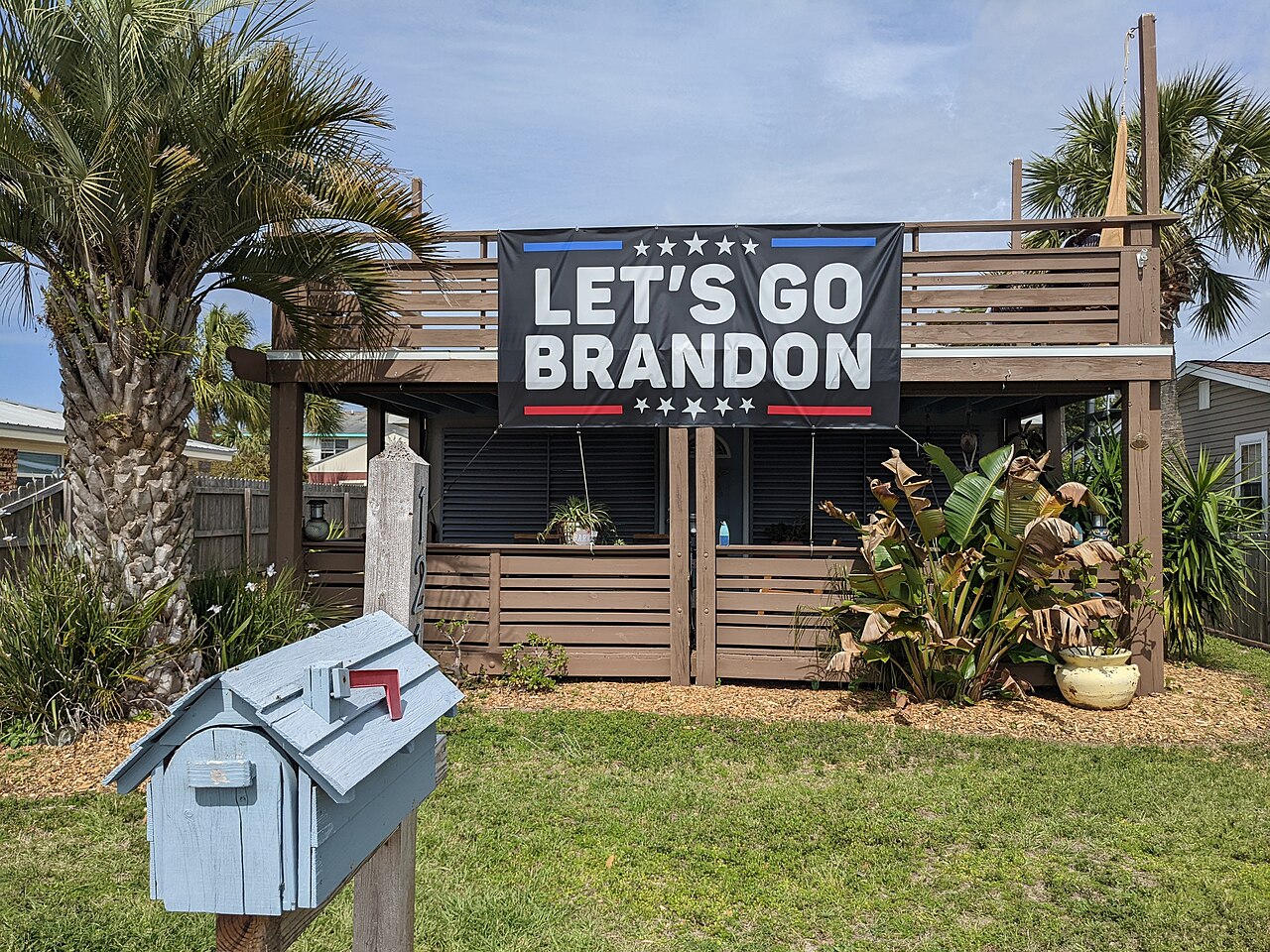
The phrase's ability to act as a stand-in for insulting President Joe Biden proved incredibly effective. It's far less polarizing than the original expletive, allowing individuals and politicians to express dissent without alienating a broader audience who might be put off by vulgarity. This "G-rated camouflage" sparked its widespread use, even among those who might not typically engage in such explicit political commentary. Protesters brandished "Let's Go Brandon" banners during Biden's visits, like a construction site in suburban Chicago and along his motorcade route in Plainfield, New Jersey. Even a Southwest Airlines pilot was reported to have used it over the loudspeaker, prompting an internal investigation. Our article
"Let's Go Brandon" Explained: Decoding the Viral Anti-Biden Cry offers more context on its rapid diffusion.
The Broader Implications: Free Speech, Political Discourse, and Unintended Consequences
The rise of "Let's Go Brandon" offers a fascinating case study in modern political communication and the evolving nature of protest. It underscores several key aspects of contemporary public discourse:
*
The Power of the Meme: In the age of social media, simple phrases or images can gain viral traction at an unprecedented pace. "Let's Go Brandon" became a political meme, easily shareable and adaptable across various platforms, contributing significantly to its rapid spread.
*
Coded Language and Deniability: The phrase demonstrates the effectiveness of coded language in political expression. It allows individuals to articulate a stance while maintaining plausible deniability, especially in professional or semi-public settings where explicit insults might be frowned upon. This characteristic makes it particularly appealing in a society that values both freedom of expression and a certain level of decorum.
*
Unintended Consequences for the "Real Brandon": While the phrase became a political touchstone, it had unforeseen and largely negative consequences for Brandon Brown, the NASCAR driver at the center of its origin. His team, already short-staffed and underfunded, found itself in a precarious position. Existing partners became hesitant to market the driver since the slogan emerged, and new sponsorship opportunities became scarce due to the phrase's association with contentious political discourse. This highlights the unexpected challenges individuals can face when their names or actions become inadvertently entangled in broader political narratives.
*
Shaping Political Identity: For many conservatives, "Let's Go Brandon" became more than just an anti-Biden chant; it evolved into a symbol of their identity, their opposition to the perceived mainstream, and their alignment with a particular political faction. It fostered a sense of community and shared purpose among those who used it.
The adoption of such a loaded phrase by public figures also raises questions about the responsibility of leaders in shaping public discourse. While it provides an outlet for dissent, it also contributes to the often-divisive nature of political conversations, potentially entrenching existing animosities rather than fostering constructive dialogue.
Conclusion
The journey of "Let's Go Brandon" from an accidental sports interview to a pervasive political slogan is a testament to the dynamic and often unpredictable nature of modern communication. It showcases how a simple misinterpretation can give birth to a powerful symbol, capable of uniting a political base and expressing dissent in a coded, yet widely understood, manner. While it effectively serves as a rallying cry for opponents of President Biden, its legacy is complex, touching upon issues of free speech, political branding, and the often-unforeseen impacts on the individuals whose names become inadvertently intertwined with such potent cultural phenomena. The phrase stands as a vivid example of how, in the digital age, a chant at a racetrack can quickly reverberate through the halls of power, reshaping the very language of political debate.